On Tuesday, April 22, terrorists attacked tourists at the Baisaran meadow in Pahalgam, killing 25 Indian nationals and one Nepali citizen, and leaving several others injured.

Speaking during an event on Saturday, Pakistani President Asif Ali Zardari revealed that during New Delhi's retaliatory strikes in May, his Military Secretary urgently advised him to move to a bunker for safety, highlighting the intense fear gripping Pakistan's top leadership amid the Indian operation.

Officials said the digital ban was intended to disrupt ideological channels that facilitate cross-border radicalisation, particularly in areas where socio-economic vulnerabilities are exploited by extremist networks.

US President Donald Trump repeated his claim at the World Economic Forum in Davos that he stopped the war between India and Pakistan, a claim India has consistently denied.

Shehbaz emphasised that water was a lifeline for Pakistan, and no compromise would be made on the country's rights under international agreements, as per Geo News.

A Pakistan that is more secure in its relations with the US is also one that might well wish to indulge in another cross-border misadventure.

Describing the visit as "productive" in a post on X, the PM said he emphasised India's position on key global issues during his engagements.

New Delhi said if the reports of Azhar's location are correct, then Pakistan's "duplicity" has been exposed as it has been maintaining that the JeM chief is not in that country.

Enforcement agencies have highlighted risks related to money laundering and terror financing, prompting closer scrutiny of crypto platforms operating in India.

Pakistan declared an 'open war' with Afghanistan following airstrikes targeting Taliban fighters in response to alleged cross-border attacks. The situation has drawn international concern, with calls for de-escalation and diplomatic resolution.
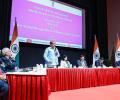
JD-U MP Sanjay Kumar Jha heads a diplomatic mission to Indonesia, Malaysia, South Korea, Japan and Singapore, to seek international cooperation after the Pahalgam attack while highlighting Pakistan's role in cross-border terrorism.

Since May 10, when Trump announced on social media that India and Pakistan had agreed to a "full and immediate" ceasefire after a "long night" of talks mediated by Washington, he has repeated his claim over 60 times that he "helped settle" the tensions between the two neighbours.
An Indian delegation led by the BJP's Ravi Shankar Prasad will tour key European capitals to expose Pakistan's role in cross-border terrorism and State-sponsored extremism.
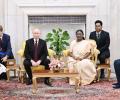
Russian President Vladimir Putin attended dinner hosted in his honour by President Droupadi Murmu at Rashtrapati Bhavan on Friday evening.

The action was carried out in connection with a case registered under various sections of Indian Arms Act, and Unlawful Activities (Prevention) Act, he said.

India strongly responded to Pakistan's remarks on Jammu and Kashmir and the Indus Waters Treaty at the UN Security Council, accusing Pakistan of supporting terrorism and violating the spirit of the Indus Waters Treaty.

Top military officials from India and Pakistan highlighted their views at the Shangri-La Dialogue in Singapore, billed as Asia's premier defence forum, amid heightened tensions between the two sides following last month's military confrontation.

India and Pakistan exchanged lists of their nuclear installations on Wednesday, fulfilling a decades-old agreement that prohibits attacks on each other's atomic facilities. The exchange took place amid strained relations between the two countries over the Kashmir issue and cross-border terrorism. The agreement, signed in 1988, mandates the annual exchange of such lists, which has occurred for the 34th consecutive year.
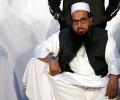
'The fight against terrorism will continue. We have set a new normal and the new normal is that we will follow an offensive strategy. Wherever terrorists are, we have to kill those terrorists and we have to destroy their infrastructure. So it is still not over but as we speak the ceasefire is still intact'

The ministry of external affairs also seemed to reject Trump's forceful comments that Washington brokered the understanding between India and Pakistan on ending their four-day military conflict.
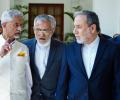
India has no intention to escalate tensions with Pakistan, but any military attacks on its soil will be met with a "very" firm response, External Affairs Minister S Jaishankar said on Thursday. Jaishankar made the remarks at a meeting with Iranian Foreign Minister Abbas Araghchi, emphasizing that the "barbaric" Pahalgam terror attack compelled India to carry out strikes on "cross-border" terror infrastructure on Wednesday. He reiterated that India's response was targeted and measured, but stressed that any further military attacks would be met with a firm response. The Iranian foreign minister, who landed in New Delhi amidst escalating tensions between India and Pakistan, called for de-escalation of the situation and stressed the need for regional cooperation to eradicate terrorism. The meeting also focused on boosting ties in areas of trade and investment, including the Chabahar port project.

While the Prime Minister did not spell out the details of the three instances, his remarks are being widely interpreted as a reference to the 2016 surgical strikes following the Uri terror attack, the 2019 Balakot air strikes after the Pulwama bombing, and the recent cross-border strikes as part of 'Operation Sindoor'.

India has suspended the Indus Waters Treaty with Pakistan, citing sustained cross-border terrorism and security concerns. The treaty, brokered by the World Bank in 1960, governs the distribution and use of the Indus river and its tributaries between the two countries. India's decision follows a recent terror attack in Jammu and Kashmir, and has been met with strong condemnation from Pakistan.
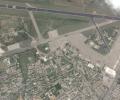
The Pakistani government has once again found itself embarrassed on the world stage, now acknowledging the impact of India's strategic and precision strikes on its military installation during the escalation in May, following Operation Sindoor, which came in retaliation for the April 22 Pahalgam terror attack that killed 26 civilians.

Pakistan added that it is necessary to establish "veracity of the Indian claim".

Since May 10, when Trump announced on social media that India and Pakistan had agreed to a "full and immediate" ceasefire after a "long night" of talks mediated by Washington, he has repeated his claim over 70 times that he ended the conflict between India and Pakistan.
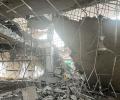
'India won't take anything from Pakistan lying down.'

'I have no doubt the players share the compassion and feeling of the vast majority of the Indian public.'
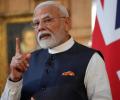
Prime Minister Narendra Modi and his British counterpart Keir Starmer discussed the need to prevent the misuse of democratic freedoms by extremist ideologies. They also addressed terrorism and trade ties.

This came after Pakistan People's Party chairman Bilawal Bhutto Zardari on Saturday stated that Pakistan's Prime Minister Shehbaz Sharif had tasked him to lead a delegation to present Pakistan's case on the recent escalations of tensions between the two nations.

All India Majlis-e-Ittehadul Muslimeen MP Asaduddin Owaisi, part of the all-party delegation led by Bharatiya Janata Party MP Baijayant Panda, said that terrorist groups wrongly use religion to justify killing innocent people.

India said on Thursday that it desired normal relations with all its neighbours, including Pakistan, and advised Islamabad to create a conducive atmosphere, including by taking "credible, verifiable and irreversible actions" to stop cross border terrorism against it and enable the two countries to engage and address issues bilaterally.

US Secretary of State Marco Rubio on Thursday spoke separately with External Affairs Minister S Jaishankar and Pakistani Prime Minister Muhammad Shehbaz Sharif, emphasising the need for de-escalation and reiterated his calls for Pakistan to take concrete steps to end any support for terrorist groups.
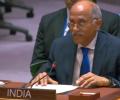
India has slammed Pakistan at the United Nations, accusing the country of illegally occupying the territory of Jammu and Kashmir and demanding its immediate vacation. India's Permanent Representative to the UN, Ambassador Parvathaneni Harish, made these remarks during a UN Security Council Open Debate on Advancing Adaptability in UN Peace Operations. He asserted that Jammu and Kashmir was, is, and will always be an integral part of India. Harish's statement came after Pakistan raised the issue of Jammu and Kashmir during the UNSC open debate, prompting a strong retort from India. He further stated that Pakistan's repeated references to the issue neither validate their illegal claims nor justify their state-sponsored cross-border terrorism. India, however, said it will refrain from exercising a more elaborate Right of Reply, suggesting a measured approach to the situation. Relations between India and Pakistan have been strained since India abrogated Article 370 of the Constitution in 2019, revoking Jammu and Kashmir's special status.

Another official said that India is planning to enhance its current hydropower capacity of around 3000 megawatts on the rivers that were earlier being used by Pakistan and a feasibility study in this regard is planned, the official said

India had vehemently opposed Asian Development Bank's decision to grant $800 million loan to Pakistan saying the fund could be misused for increasing expenditure on its military, government sources said.
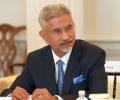
External Affairs Minister S Jaishankar says Operation Sindoor conveyed India's resolve to act against terrorism, following UN Security Council's call to bring Pahalgam attackers to justice.
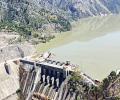
India has suspended the Indus Waters Treaty with immediate effect, accusing Pakistan of breaching the pact by refusing to negotiate modifications and engaging in sustained cross-border terrorism. The decision follows a recent terror attack in Jammu and Kashmir that killed 26 people. Pakistan has rejected India's move, calling it an "act of war."
'Surgical strikes or air strikes, or both, are likely on the table.'

A cross-party delegation led by Congress MP Dr Shashi Tharoor is visiting key American nations to rally global support for India's counter-terror stance under Operation Sindoor, spotlighting regional stability and Pakistan-backed cross-border threats.
